“We are who we are, not who we’re gonna be/ Every passing moment is ancient history,” Eric Brace and Peter Cooper sing in “Ancient History,” the first track on their latest CD, The Comeback Album. It’s a good choice for an opener, a catchy meditation on identity, impermanence and possibility that name-checks a range of people and places including Muhammad Ali, Jerry Jeff Walker, Sid Bream and the Astrodome.
It’s also a fitting start for a project by two Nashville singer-songwriters who seem to know a thing or two about personal reinvention. Brace is a former Washington Post music journalist who now runs the label that released this CD as well as fronting a band called Last Train Home; Cooper, among other jobs, is still writing about music (for The Tennessean in Nashville) as well as performing it and teaching college classes about it. As if that weren’t enough, each has a solo album scheduled for release later this year.
Comeback, their third collaboration, is marked by the kind of literate songcraft you’d expect from people who make their living with words. Brace and Cooper wrote or co-wrote nine tracks and covered three others. Best bets among the originals include “Thompson Street,” about a scruffy neighborhood in Spartanburg, S.C., and its colorful inhabitants; “She Can’t Be Herself,” a twangy and rueful goodbye song; “Nobody Knows,” a bouncy ode to life’s uncertainties, and “Boxcars,” whose upbeat tone is at odds with its theme of loss and regret.
The covers are well chosen too: Tom T. Hall’s “Mad,” a classic country tale of carousing and consequences; Karl Straub’s “Carolina,” a sweetly played ballad of alienation, and David Halley’s sad country waltz “Rain Just Falls.”
To go with their own guitars and harmonized vocals, Brace and Cooper get some great backup here, from the likes of Lloyd Green on pedal steel, Dave Jacques on bass, Jen Gunderman on keyboards, Fats Kaplin on violin and mandolin, and Rory Hoffman on a host of instruments, from clarinet and accordion to practically anything with strings. Listed as “special guests” on “Mad” are Mac Wiseman and Marty Stuart on vocals (Stuart also contributes mandolin) and Duane Eddy on guitar.
This kind of music is about the storytelling as well as the playing, and Brace and Cooper excel at both.
There’s a moment on the Chet Atkins and Les Paul album Guitar Monsters (Real Gone Music) where the two playfully compare notes on CB radio and Dolly Parton’s attributes. It’s an exchange that simultaneously signals just how long ago Atkins and Paul recorded the LP, and how much fun they had doing it.
This 1978 album, their second together, showcases the two virtuoso guitarists in a playful and informal setting. Paul came from pop and jazz and Atkins from country, but they admired each other and their talents were truly complementary on this release.
“Over the Rainbow,” “I Want to be Happy” and “Give My Love to Nell” are musical highlights, and you’ll enjoy the pair’s spirited banter on “I’m Your Greatest Fan.”
Blue Corn Music has released Steve Forbert’s first two albums in a deluxe package that includes 12 bonus songs. It’s a reminder of just how rare it is for a singer-songwriter to release two consistently excellent albums at the outset of a career.
Neil Young did it. So did Jackson Browne and James Taylor. But Elton John didn’t (Empty Sky was no Elton John.) Carole King didn’t, although Tapestry was a heck of a second album.
Forbert’s Alive on Arrival was a vibrant debut, sporting enduring songs like “Goin’ Down to Laurel” and “You Cannot Win if You Do Not Play.” For an encore, Forbert delivered the ambitious Jackrabbit Slim, kicking off the LP with “Romeo’s Tune,” an idiosyncratic hit record that he’s played for more than three decades.
Forbert is an amazingly consistent artist and every album offers up new treasures. You can have that kind of career when you build on a foundation of quality, as evidenced by this new collection.
Complete Original #1 Hits – Eddy Arnold
Album titles don’t come any more straightforward than this one. This Real Gone Music release includes the 28 Eddy Arnold songs that rose to #1 on the Billboard country chart, beginning with “What is Life Without Love” in 1946 and concluding with “The You Can Tell Me Goodbye” in 1968.
It’s a rich anthology that tracks both Arnold’s early career and the evolution of country music. Arnold’s use of strings and lush arrangements broadened his appeal well beyond country music audiences. Highly recommended.
Americana Music News — Dates for Patty Griffin’s U.S. and UK tour have just been announced. The tour supports the release of her New West album American Kid.
The schedule:
Americana Music News – Courtney Jaye, a Nashville-based artist whose new album Love and Forgiveness draws on classic pop, will appear at an in-store at Grimey’s in Nashville on May 7, the album’s release date. She’ll also perform at the Stone Fox in Nashville on May 10.
We don’t understand the reference to Neil Young and the Band in the press materials, but we can certainly hear the influences of Jackie DeShannon, Petula Clark and Linda Ronstadt. That’s plenty for us.
35 years on, Nile is making some of the most ambitious and rewarding music of his career.
American Ride builds on the spirit of his fine 2011 album The Innocent Ones and its anthemic“One Guitar.” This time around, the rousing “This is Our Time” is the opening call-to-arms.
There’s a duality evident throughout the album. Tracks like “Sunrise in New York City” and “There’s No Place Like Home” couple reassuring sentiments to sing-along arrangements. But then there’s “God Laughs,” a striking and irreverent song that will provoke reflection, indignation and laughter, but not from the same people. And in the middle of all this is a sterling cover of Jim Carroll’s “People Who Died.”
American Ride is all over the road, but in a very good way.
Rendezvous in Rhythm –Hot Club of Cowtown – Gold Strike Records
The Hot Club of Cowtown – Elana James, White Smith and Jake Erwin – has delivered a thoroughly charming collection of jazz standards, with a nod to Left Bank influences. It’s just fiddle, bass, guitar and vocals, intimate and energetic at the same time. Favorite tracks: “Avalon” and “The Continental.”
Go Jane Go – Dead Reckoning Records
Fans of Kieran Kane, the Dead Recknoers and David Francey are in for a treat with the release of Go Jane Go. This collaboration teaming of Kane, Francey and Lucas Kane grew out a tour of Australia. It’s stripped down and as basic as Americana music comes, delivering strong songs in an intimate setting.
The Bright Spots – Randall Bramblett - New West Records
Here’s an impeccably soulful album by Randall Bramblett, a storied session musician and former member of Sea Level. He’s also a fine writer and vocalist, bringing to mind Bonnie Raitt and late-period Nick Lowe.Favorite tracks: “Til the Party’s Gone” and “My Darling One.”
A Date with the Everly Brothers – The Chapin Sisters – Lake Bottom Records
Cribbing the title of this collection from a classic Everly Brothers LP, the Chapin Sisters deliver faithful covers of some of Don and Phil’s best work.It’s a fun listen that includes some surprising song selections.
–Gurf Morlix Finds the Present Tense is “the feel-good album of the year.” That’s how the Austin-based singer-songwriter described his latest CD during a recent in-store performance in Houston. He was kidding, of course. A better description of his outlook can be found in “Lookin’ for You,” the second track: “You know I like it/Dark and hot/Torn and twisted/Tied in a knot.” Such are the conditions many of Morlix’s characters seem to find themselves in.
“My Life’s Been Taken” is the lament of a man paying a high price for a bad decision, while “Series of Closin’ Doors” could well describe the process that leads to such a decision. The foreboding organ that dominates another track, “Present Tense,” is echoed by the lyrics – “I’m feeling heavy vibrations/Find the present tense.”
Morlix deals mostly with personal matters, but political commentary makes an appearance in “Bang Bang Bang,” an indictment of America’s gun culture that includes a reference to his old friend Blaze Foley, an underrated singer-songwriter who was shot to death during an argument in 1989. The song’s bouncy tone can’t disguise Morlix’s pain over Foley’s death – “Shot down, gone away/Gone forever, miss him every day” – or his outrage at the violence that led to it. “Guns in backpacks, guns in schools/We’re a bunch of gun-carryin’ fools,” he concludes.
It’s back to the darkly personal in the CD’s final three songs. Morlix’s raspy voice and a twangy country arrangement are perfectly suited to the raw pain of “You Walk Away,” in which he asks, “All these years, don’t they count for nothin’?/Don’t you remember our last kiss?” “These Are My Blues” finds the narrator a little farther down the road, still hurting and not in any big hurry to feel better. The CD wraps up with “Empty Cup,” a plea for the love that proves so elusive. “I’m a simple man, I can’t decipher your clues,” Morlix sings. “All I know is, I can’t live without you.”
Morlix’s songs are well served by his understated production, and by the strong contributions of backing musicians including drummer Rick Richards, keyboardist Ian McLagan, violinist Gene Elders, and singer Eliza Gilkyson, among others.
Having worked with Lucinda Williams, Robert Earl Keen and many others over the years, Morlix is probably better known as a sideman and producer than as a solo artist. But he’s got his own story to tell, and he does a pretty good job of it on this collection. It’s not a very uplifting message, but it’s worth a listen.
Follow Sun209: Americana Music News on Twitter at @Sun209com.
Americana Music News – The Tin Pan South Songwriters Festival kicks off tonight with a full and varied schedule, combining songwriting prowess with a little star power.
Among the highlights:
It would be easy to just spend the evening at 3rd and Lindsley, with strong shows at both 6 p.m. and 9 p.m. First up is “From Texas to Tennessee,” featuring Wade Bowen, Radney Foster, Jon Randall and Bruce Robison. The 9 p.m. show cereblates the ABC TV show “Nashville,” and is anchored by Colin Linden and Buddy Miller, both with ties to the show. Special guests are promised.
Also at 9 p.m. Charles Kelley of Lady Antebellum is joined by Dave Barnes and Kevin Griffin at the Listening Room Cafe.
A 9 p.m. show at the Rutledge features some of Nashville’s hottest songwriters, including Luke Laird, Natalie Hemby and Brett Eldredge.
–There’s no denying that Guy Clark’s March 23 concert at the historic Crighton Theatre in Conroe, Texas, had the air of a memorial service about it. The legendary singer-songwriter, a Texas native who’s lived in Nashville for many years, has been in ill health for several years; it seems likely that his ailments and possibly age (Clark turned 71 in November) are behind recent declines in his singing, playing and memory.
But if the audience came to pay its respects, that wasn’t necessarily what the object of their admiration had in mind. After walking slowly onstage with the help of a cane (a souvenir, perhaps, of a broken leg suffered a few years ago), Clark opened the show with three songs from a forthcoming album: “I’ll Show Me,” a how-to guide to being one’s worst enemy; “My Favorite Picture of You,” a tribute to his beloved wife, Susanna, who died last year, and “El Coyote,” about the grim business of immigrant smuggling in South Texas. Accompanied throughout the show by his old friend Verlon Thompson, himself an accomplished songwriter and performer as well as a monster guitar player, Clark followed with a couple of older favorites: “The Cape,” an ode to the power of faith, and “Like a Coat from the Cold,” an earlier valentine to Susanna.
Then Clark made the first of two temporary exits from the stage – “There’s something in my throat,” he said, before relating how his pants fell down in the course of a similar exit during a show a few days earlier. Thompson was left to fill in, a task he handled with impressive style and grace. Suddenly solo, he played “Everywhere … Yet,” a lively name-check of many venues he’s played over the years, and a look forward at more to come (“We ain’t been everywhere … yet”) and “The Guitar,” co-written with Clark, which skated the line between eerie and hokey, but served as a fine vehicle for Thompson’s acoustic guitar wizardry.
One of the more moving aspects of the show was Thompson’s humorous attempts to ease the awkwardness caused by Clark’s frequent hesitations and memory lapses as he struggled to get through the songs he once played so fluidly. After Clark returned from his first hiatus, complaining of feeling queasy and sighing, “I don’t know how I do it,” Thompson got some laughs with the comeback, “Let’s hold off on your food songs for now.” What followed was a lovely sequence that included “L.A. Freeway” and “She Ain’t Goin’ Nowhere” (of which Clark said, “This is actually my favorite song”).
The reverent atmosphere was broken by a volley of shouted requests, but the sometimes irascible Clark wasn’t having it. “Just settle down,” he told the audience, in a tone that didn’t sound all that lighthearted, “and let me get this taken care of.” After a pause, he moved on to “The Randall Knife,” with the help of some lyrical prompting from Thompson; “Homegrown Tomatoes,” which fortunately didn’t provoke any unpleasant side effects, and “Boats to Build,” in which Clark and Thompson traded verses.
Clark also seemed to be trying to lighten the mood by making light of his own infirmities. “I’m playin’ hurt, man,” he told Thompson at one point, to which the reply was, “Yeah, and there ain’t a relief man in the bullpen.” Thompson, of course, was the relief man, giving Clark a breather by launching into a spirited rendition of “Joe Walker’s Mare.” After a second slow exit by his friend, Thompson continued with several originals about his parents in Oklahoma – “Sweet Dreams,” “Darwettia’s Mandolin” and “Caddo County.”
Upon his return (accompanied by the sweet tones of what Thompson called “traveling music”), Clark closed out the set with two final favorites, both tributes, at least in part, to his late wife – “Stuff That Works” and the beautiful and moving “Dublin Blues.”
There’s something to be said for leaving at the top of one’s game; for Guy Clark that may no longer be an option. But there’s also a lot to be said for giving one’s fans another chance, maybe a last chance, to show their love and appreciation, and it’s fair to say that the large majority of those in attendance were happy to get that chance.
Austin singer-songwriters Brennen Leigh and Noel McKay opened the show with a well-received set that showcased their songwriting abilities, fine harmonies and impressive guitar skills. Highlights included the very funny “Let’s Go to Lubbock on Vacation” and “That’s What I Meant to Say,” in addition to grittier fare such as “Sleeping with the Devil.”
Follow Sun209: Americana Music News on Twitter at @Sun209com.
–Down Side Up from Old Man Markley is a riveting, high velocity bluegrass album, with surprisingly potent political content. There’s been some marketing effort to label this as a cross between bluegrass and punk, but that’s trying too hard. The only Clash-like elements are the highly topical lyrics. “The corporate propaganda paralyzes us with fear, destroying our ability to trust,” the band warns in “America’s Dreaming.”
There’s irreverence throughout, including “Beyond the Moon,” in which we learn the singer doesn’t “wanna lose my mind like Gary Busey did.”
This isn’t “newgrass,” but the topicality suggests “Newsgrass.” Old Man Markley features fine playing throughout, with bonus points for attitude.
Upcoming tour dates for Old Man Markley:
Mar 21 – Denver, CO – Marquis Theater
Mar 22 – Salt Lake City, UT – Burt’s Tiki Lounge
Mar 23 – Las Vegas, NV – Beauty Bar
Mar 24 – Fullerton, CA – The Slidebar
Mar 28 – San Diego, CA – House of Blues
Follow Sun209: Americana Music News on Twitter at @Sun209com.
I’m not sure I’ve seen a tribute album this deep in talent and most of it is straight out of Nashville. Dolly Parton, John Prine, Alison Krauss and Rodney Crowell join another 18 artists in this salute to a talented and under-recognized songwriter.
I knew Davies’ work primarily from the versions of his “It Ain’t Easy,” recorded by David Bowie on Ziggy Stardust and by Long John Baldry on the album of the same name. Impressive as those cuts were, Davies’ catalog runs deep and it’s showcased beautifully here.
His sister Gail Davies organized and produced the album to celebrate her late brother’s work. Unsung Hero benefits the W.O Smith Music School in Nashville.
In his lifetime, Ron Davies must have generated a tremendous amount of goodwill. That’s reflected in the roster of their performances and the clear admiration shown throughout.
The highlights include Jeff Hanna and Matraca Berg’s version of Dark Eyed Gal, first recorded by Jeff with the Nitty Gritty Dirt band, Guy Clark’s take on “Walk and Don’t Walk,” Krauss’ “Good Lover After Bad” and Prine’s “You Stayed Away Too Long.”
But that just scratches the surface. This album is 22 strong songs deep, including performances by John Anderson, Jim Lauderdale, Delbert McClinton, Mandy Barnett, Crystal Gayle, BR549, Jimmy Hall, Suzy Bogguss, Vince Gill, Kelly Hogan, Kevin Welch, Jonell Mosser, Robbie Fulks, Bonnie Bramlett and Gail Davies.
–This live set from Texan Nick Verzosa and his bandmates is pretty standard bar-band stuff. Drinkin’, dancin’, lookin’ for love, gettin’ over lost love and so on – you’ve heard it before. But some things here give cause to hope for bigger and better things.
Verzosa’s writing is a notch better than the usual for this genre and he’s got some talented people playing with him. Maybe more important, he’s forged connections with some better-known people in the music business: musician/producer Walt Wilkins produced a couple of earlier projects, one of which featured a guest appearance by guitarist and producer Rich Brotherton.
Verzosa, another in a line of singer-songwriters graduated from the improbable hotbed of Texas A&M University, wrote 11 of the album’s 14 tracks and co-wrote two others (the remaining track was written by his bassist, Shawn McGee).
Some standouts:
“I Wouldn’t Answer,” a ballad in which he advises an ex NOT to give him another chance, featuring some nice electric guitar by Matt Gracy and harmony vocals by Courtney Stefan
“7th Year Senior,” a twangy tribute to a longer-than-usual college career (his introduction to the song concludes with “Take it from me, kids, stay in school!” )
“Stronger Than That,” a bad-love ballad in waltz time that again showcases guitarist Gracy and solid playing from bassist McGee and drummer Danny Poole
“She Only Loves Me (When I’m Leaving),” a bouncy love lament co-written with singer-songwriter Matt Harlan “Back When Love Was Easy,” a bittersweet look at the reality of a relationship after the initial euphoria fades; the song wraps up with band introductions and a crowd-pleasing snippet of the Eagles’ “Already Gone.”
Nick Verzosa seems to have a lot going for him – writing chops, a good ear for melodies and catchy hooks, and a road warrior’s work ethic. This collection has some rough edges, but plenty of energy and potential as well. This is a band worth watching.
Follow Sun209: Americana Music News on Twitter at @Sun209com.
By Paul T. Mueller–If you were looking for the perfect artist to anchor a concert series called “Songs of Lovin’ and Redemption,” you could hardly do better than Billy Joe Shaver. Legendary songwriter, road-dog performer, one-time connoisseur of chemical excess, committer of serial matrimony, notorious hell-raiser, born-again Christian – you’d have to figure the guy knows everything there is to know about lovin’ and redemption. Judging from his March 6 appearance at St. Mark’s Episcopal Church in Houston, you might be right.Shaver, who’s 73, moseyed up the center aisle shortly before showtime. He stood at the front of the pews and related a long story about being born again, and the dissolute life that led him to that turning point. Explaining that he’d emerged from his addictions and the withdrawal that followed only after finishing a song he’d been struggling with, he proceeded to sing that song – “I’m Just an Old Chunk of Coal,” which became one of his biggest hits – without benefit of band or instruments.
At that point his band – guitarist Jeremy Woodall, bassist Matt Davis and drummer Jason McKenzie – joined him for a full-band (albeit acoustic) reprise of “Old Chunk of Coal.” A bit shaky at the beginning and seemingly somewhat ill at ease, Shaver worked his way through a few more of his hits – “Georgia on a Fast Train,” “Old Five and Dimers Like Me,” “You Just Can’t Beat Jesus Christ” – punctuated with more life stories. “I’m a little short-handed,” he said by way of explaining his limited guitar-playing skills – holding up his right hand, minus parts of three fingers, and describing the long-ago sawmill accident that resulted in that injury.
Performing in a venue far removed from the bars that are his usual habitat, Shaver referred several times to the dissonance between the rowdy outlaw country he’s best known for and his more spiritual songs. “I hope there’s no one expecting ‘Honky Tonk Heroes,’ “ he said at one point. “I’m just not going to do that in here.” But after a few more of the softer songs, and a couple of audience calls of “Thunderbird!”, the church’s rector, the Rev. Patrick J. Miller, held a brief conference with Shaver and apparently gave his blessing, so to speak, to Shaver’s performing some of his more worldly fare. The band then launched into “When Thunderbird Was the Word,’ “Honky Tonk Heroes,” “That’s What She Said Last Night” and “The Devil Made Me Do It the First Time” – pretty much the same stuff you’d get at a plugged-in Shaver show, minus the amplification.
Shaver talked for a while about the dangers of drugs and about how his son, Eddy, died of an overdose in 2000. He followed that with the gentle tribute “Star in My Heart,” which he told the audience “was written for Eddy and you.”
More stories and more songs ensued – “When the Fallen Angels Fly,” “Hottest Thing in Town,” “You Asked Me To,” “Ride Me Down Easy,” “Try and Try Again,” among others. Woodall’s excellent picking and string-bending made for fine accompaniment, and an interesting contrast to the full-on electric sound that’s been the hallmark of Shaver’s bands for many years. Bassist Davis improvised his lines on an acoustic guitar, while drummer McKenzie wowed the crowd with an impressive display of percussion skill using only bongos, brushes and a few small instruments.
After a standing ovation, Shaver promised “a couple more” and took off on a long tale involving youthful marriage, breakups, truck repair, panhandling, carousing and despair, all of which led into a rowdy rendition of “Ragged Old Truck” that left a knocked-over mic stand lying on the floor. He finished “The Road,” a slower, almost mournful ballad featuring Woodall’s beautiful Spanish-style playing. “Love me one more time before I go,” the song ends, and by that point there was plenty of love to go around – the audience’s for Billy Joe Shaver, and his for them.
“Songs of Lovin’ and Redemption,” put together by the Rev. Miller and the Rev. Eric P. Hungerford (the church’s rector and associate rector, respectively) continues with Sara Hickman on March 13 and Terri Hendrix on March 20.
Follow Sun209: Americana Music News on Twitter at @Sun209com.
New to the chart this week: Sons of Fathers’ Burning Days, Josh Ritter’s The Beast in his Tracks, Otis Taylor’s My World is Gone, Kevin Deal’s There Goes the Neighborhood and Rich Mahan’s Blame Bobby Bare.
Speaking of Bobby Bare, his Darker Than Light is the most-added album in Americana music radio this week, followed by Wayne Hancock’s Ride and the James Hunter Six’s Minute By Minute.
Follow Sun209: Americana Music News on Twitter at @Sun209com.
It could have been, in Lyle Lovett’s words, “Mardi Gras energy” that made his Feb. 12 acoustic show with fellow Texas singer-songwriter Robert Earl Keen so special. Or maybe it was the fact that the two – college buddies, one-time co-writers, occasional collaborators, world-class musicians – were playing a long, relaxed set in a beautiful venue in front of a standing-room-only crowd.
Whatever the reason, the energy was there on Fat Tuesday in the Grand 1894 Opera House in Galveston, Texas. As revelers partied on in the nearby streets, Lovett and Keen, their microphone stands adorned with strings of beads, took turns singing their own songs and a few covers. Playing only guitars – Lovett’s strung with steel, Keen’s with nylon – they contributed riffs and the occasional solo, along with some nice vocal harmonies, to each other’s efforts. Between songs, well-known favorites and seldom-heard gems alike, they amused the audience (and each other) with hilarious tales spanning the arc of their careers, from novice performances in Texas A&M’s Basement coffeehouse to headlining shows all over the world.
One chill-inducing moment came about 90 minutes into the 2½-hour show, when Keen’s performance of “Rollin’ By,” his beautiful elegy to the expansive landscape and dying small towns of West Texas, turned into one of the evening’s few duets. Lovett’s reading of Keen’s evocative lyrics matched his partner’s quiet intensity, and the result was a vivid demonstration of the power of song. The end of the main set brought more of the same, as the two traded verses on their co-written “The Front Porch Song,” and the show-ending “Ain’t No More Cane,” a quieter, but no less powerful, treatment than Lovett’s full-band version on a recent album.
In between, more highlights than can be mentioned here: Keen’s “Merry Christmas from the Family,” which Lovett proclaimed “the best Christmas song ever written”; Lovett’s somber “Family Reserve”; Keen’s powerful “Shades of Gray”; Lovett’s jazzy take on the comically romantic “Her First Mistake,” which earned him enthusiastic applause from his partner; Keen’s sweet road tale “I’m Coming Home”; Lovett’s rendition of the Grateful Dead’s “Friend of the Devil”; Keen’s “It’s the Little Things,” possibly a backhanded salute to the impending Valentine’s Day, and Lovett’s all-out performance of “My Baby Don’t Tolerate.”
Final score: About two dozen songs, a lot of funny stories, and around a thousand happy fans leaving the historic hall to the recorded strains of “Galveston” and “Together Again.” Magic indeed.
Follow Americana Music News on Twitter at @Sun209com.
Americana Music News – No surprise, but the top album in Americana music this week is Cheater’s Game by Kelly Willis and Bruce Robison. The album jumped into the chart last week in the sixth slot, with almost 50 radio stations adding it in a single week.
By Paul T. Mueller
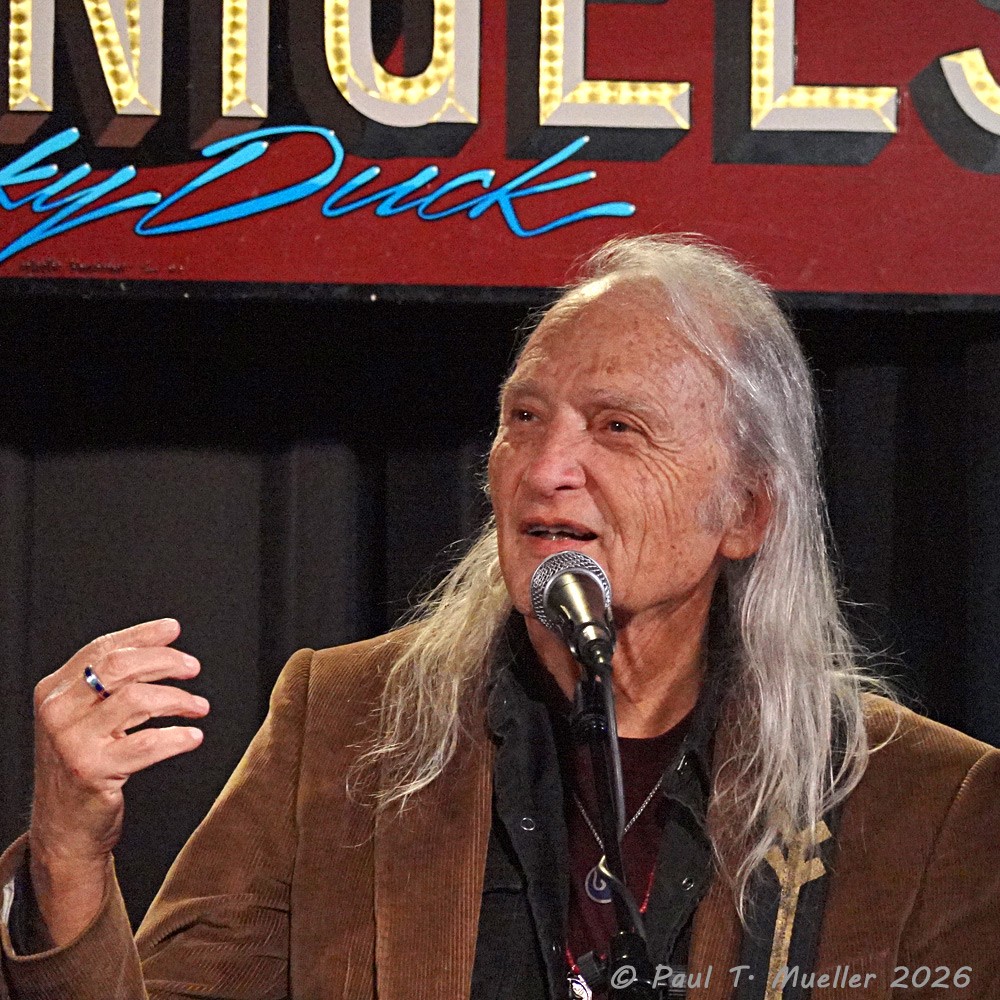
–Terry Allen played most of his Jan. 19 late set at McGonigel’s Mucky Duck in Houston with a small, secret smile on his face, as if anticipating the punch line to an upcoming joke. Fortunately for the standing-room-only audience (the second of the evening), he didn’t keep the humor to himself, sharing it generously over the course of more than 20 songs and some highly entertaining between-songs banter.
That’s not to say that Allen, a longtime resident of the High Plains of Texas, is a comedy act. Violence and other misbehavior also feature prominently in his gritty narratives, many of them set in the American Southwest and Mexico. Allen’s songs, several of which have been covered by better-known artists, are marked by his quirky outlook and the vivid imagery one might expect from a painter (another of his job descriptions, which also include sculptor and dramatist).
Backed by a capable if unconventional band – his son Bukka on accordion and percussion, Richard Bowden on violin and mandolin, and Brian Standefer on cello – Allen romped through a mix of old favorites and newer material, including seven tracks from his excellent new CD, Bottom of the World.
Some highlights:
“Amarillo Highway,” a rocking tribute to the road warriors of the West Texas blacktop
“Beautiful Waitress,” an offbeat love song of a sort
“Queenie’s Song,” a vitriolic message to the unknown person who shot and killed Allen’s dog Queenie in 1999 (Allen co-wrote the song with the legendary Guy Clark, and his description of Clark’s reaction to the news of Queenie’s demise was worth a good chunk of the ticket price all by itself)
“Sidekick Anthem,” a sweet tribute to Allen’s wife, Jo Harvey
“Gimme a Ride to Heaven, Boy,” a very funny tale about a late-night encounter with a dubious deity on a lonely highway
Allen closed out a several-song encore with “Give Me the Flowers,” in which he suggests that flowers work better as gifts to the living than as remembrances of the dead.
Terry Allen was in fine form and terrific voice for this show, but one could be forgiven for wondering how many tours a man pushing 70 has left in him. Fans of this unique voice in American music might do well to take his floral advice and reward him with the flowers of their attention sooner rather than later.
Follow Sun209: Americana Music News on Twitter at @sun209com.
It’s not always easy to tell what singer-songwriter Drew de Man is trying to say. The subtitle of his Tumblr site reads “Exploring and expanding the roots and branches of rocknroll poetry.” His lyrics tend toward imagery that’s often obscure and sometimes seemingly random. All this may have something to do with geography: de Man is a Georgia native who used to live in Atlanta, where he attended college and later spent several years fronting alt-country outfit No River City. He moved to Portland, Ore., a while back, and his more recent music seems to reflect the looser, hipper vibe of the West Coast.
What hasn’t changed is de Man’s ear for melody and his skill on a variety of instruments. The album’s nine songs feature plenty of nicely played guitar, both acoustic and electric, as well as the other things you might expect – bass, piano, drums – and some you might not – jaw harp, tanpura (something like a sitar), and udu (an African percussion instrument). It adds up to an interesting mix that’s fun to listen to.
Picking obscure instruments out of the mix is easier than describing de Man’s lyrics, but here’s a start. “Kingsferry” is a kind of road tale, played in a catchy, Tom Pettyish way. “Unspeakable Things” reads like something of a memoir, fueled by guitar riffs that Keith Richards wouldn’t be ashamed of. “The Luckiest Guy” is countrified love ballad, played in a style that recalls the Grateful Dead’s acoustic side. “I’d Give a Whole Lot,” the closing track, is a slow, mournful song that seems to be a tribute to a musical hero of de Man’s youth. “I’d give a whole lot,” he sings, “just to hear him play again.” Jerry Garcia? Duane Allman? Hard to say – maybe it’s best to just sit back and enjoy.
Follow Sun209: Americana Music News on Twitter at @sun209com.
Americana Music News – The hottest album in Americana music this week is Cheater’s Game by Kelly Willis and Bruce Robison. The album breaks in at number 6 on this week’s Americana music radio airplay chart, and was also the most added release, with 46 stations picking it up.
The Cowbopsters are back with their fourth album called Cowlifornia Swing, and there are plenty of both western and jazz influences apparent. Much like their last album (“Too Hick for the Room”) we hear guitarist Bruce Forman, vocalist Pinto Pammy (Forman’s wife), bassist Alex King and drummer Jake Reed. The quintet has also added David Wise on saxophone and cornet. On several cuts, guests fill out the new album with tints of piano, fiddle, trombone, cello, mandolin and accordion. All are hot tunesters with solid credentials. Bruce Forman teaches jazz guitar at USC’s Thornton School of Music, and others in the band are (or were) students there. Like their last successful album, Thornton alumnus Doug Gerry produced, and faculty member Andrew Garver mastered.
“Spade” Cooley coined the term “Western Swing” in the early 1940s, and it’s interesting that “Spade” was a Los Angeles resident like the members of Cow Bop. He had fortune and fame, but was imprisoned in 1961 for murder. Despite the thousands of bands playing all over the West during the heyday of Western Swing, the genre is most closely associated with Bob Wills and his Texas Playboys. Cow Bop pays tribute to them with a boss arrangement of “Roly Poly” that wisely includes Phil Salazar’s fiddle, the only cut with that classic western swing instrument, albeit played electric on this song.
Cow Bop’s approach to bovine boogie also taps jazz standards (“I’ve Found a New Baby”), pop fare (“These Boots are Made for Walking,” “Mambo Italiano”), country (“Cattle Call”), western (“Wahoo”), and some less oft-heard big band tunes (“A Gal in Calico”). The jazz chops predominate in these uplifting tunes and make for an enjoyable listen. We also hear Pinto Pammy’s countrified sounds, like yodeling in “Cattle Call” and call-and-response (with David Jackson) in the novelty number “Wahoo.” She’s also comfortably smooth with a swinging version of “Indian Love Call,” quite unlike the rendition done by Nelson Eddy and Jeanette MacDonald. Six-minute offerings like “What is this Thing called Love?” and “These Boots are Made for Walking” allow multiple instrumentalists to showcase with improvisation between verses. The arrangements are solid, but I wonder if they write any originals.
While some of Cow Bop’s influences are clearly organic and corn-fed, Cow Bop’s jazzy twang also provides a copious amount of toe-tapping fun. There may not be many big roadhouses and dancehalls left today, but you can catch this band at fairs, festivals, cafes, rodeos, burger joints and places like the Viva Cantina in Burbank. I haven’t ever been there, but I imagine it as a place where young folks, old-timers, friends and neighbors all know each other and gather for listening or dancing the night away. Hailing from busy and heavily populated Southern California, Cow Bop’s music conveys a rural ethos, but also demonstrates an urban, contemporary understanding. Cowlifornia Swing is music for dancing so roll up the rug, throw some cornmeal on the floor, invite the neighbors over and throw a party to their music.
Follow Sun209: Americana Music News on Twitter at @Sun209com.
– When Junior Brown’s twangy “Hang Up and Drive” opens his new EP album, Volume Ten, you hear an element of Dave Dudley’s “Six Days on the Road.” However, if you think this six-song project is all retro truck-driving country music, think again. While the opener is a variation of honky tonkin’ country that lyrically captures a trucker’s lifestyle, the next cut “Apathy Waltz” (with just guitar, bass and voice) is a humorous and jazzy song about desensitization and detachment.
Junior Brown’s bass voice tells us about your “play button being stuck on pause.” With today’s information overload, I can particularly relate to his verse about computers, keypads, cell phones, WiFi, cameras and “sci-fi style picture-phone Skype-sa-call….” The song ends with Junior’s big yawn, but it’s anything but boring.
“I’m Headed Back To Austin Tonight” is pure unadulterated western swang with Junior’s steel guitar and piano in the forefront. I was overjoyed to hear fiddle finally make its appearance about two minutes into the song, but I was a tad disappointed to not hear any vocal harmony on the chorus or hook.
A new story song, “The Phantom of the Opry,” relates the secret life of a country musician living in the basement of an old opry house since 1975. Like that phantom, Junior believes in keeping his music “sweet and clear, the way they played it here on Saturday nights.” But Junior is no ghost or relic from another life, and his music is both classic and contemporary.
A popular concert draw, the larger-than-life artist has built a legion of fans who enjoy his low voice, twangy double-necked “Git-Steel,” witty humor, smart songs and classic-styled presentation. “Trust Me” is slow country blues with a pointed reference to Tricky Dick. Closing the album instrumentally, Buddy Charleton’s “Almost To Tulsa” sounds like a jam, but gives all the musicians a chance to showcase their talents. It’s the only cover on the album, and the late Charleton would be happy that Brown’s finally recorded the piece.
I remember first seeing Junior Brown and band when they appeared at our “Music on the Halfshell” series in Roseburg, Oregon. I immediately understood the phenomenon of this unique individual who celebrated his 60th birthday in 2012. Based in Austin, Texas, the award-winning Brown has been at it for more than five decades, and he clearly knows what it takes to entertain and get people up dancing. He’s a legend, and I only wish he’d give us more than six songs on future volumes. But this is his first release in seven years, so we should be happy at that.
RT @JeffWoodsRadio: Damn. Gone today at the age of 62, legendary bassist from Bowie’s Spiders From Mars – Trevor Bolder. Cancer. http://t.… 18 hours ago
RT @AmericanaFest: To all those in the UK & Europe, don’t miss Lucinda Williams (@HappyWoman9) when she plays your city! http://t.co/dcBARO… 18 hours ago
RT @ronnyboy1: So pretty. Nashville’s Music City Center opening! Songwriters Hall of Fame #picstitch @ Music City Center http://t.co/IUHH4S… 3 days ago
RT @JasonIsbell: Couple misquotes in the Garden and Gun piece. 1st, it was Elizabeth Cook, not Patty Griffin, who told Letterman about us. 4 days ago
RT @KellyWRobison: Recovered from the 2 beers I drank at Lloyd Maines tribute just in time for tonight’s gig-Pflugerville Fest!! Tonight’s … 4 days ago
RT @SteveEarle: Boston, thanks to everyone who supported the Give US Your Poor table this past Sunday . This was a part of Give… http://… 4 days ago
RT @RonSexsmith: Produced by Steve Earle, It sounds more like a demo to me than a proper record but it has a few good songs on it RS http:/… 4 days ago
RT @AmericanaFest: THANK YOU @BuddyandJim for making yesterday’s Americana Nomination Ceremony extra special & fun. We love u guys!! http:/… 7 days ago
RT @HonkyTonkShell: Kip Moore, Will Hoge, more entertain crowd at Grammy block party | Tune In Music City | The Tennessean http://t.co/3uGQ… 7 days ago
Sun209 chronicles rock, roots and Americana music, drawing its name from the catalog number of Elvis Presley's first single, the Big Bang of contemporary music.
Review copies and press releases: PO Box 432, 3908 Lebanon Pike, Hermitage, TN 37076.
E-mail: sun209editor@gmail.com.